Farmers in Punjab and Haryana are adopting affordable residue management technologies to reduce stubble burning, improve soil health, and support sustainable farming practices.
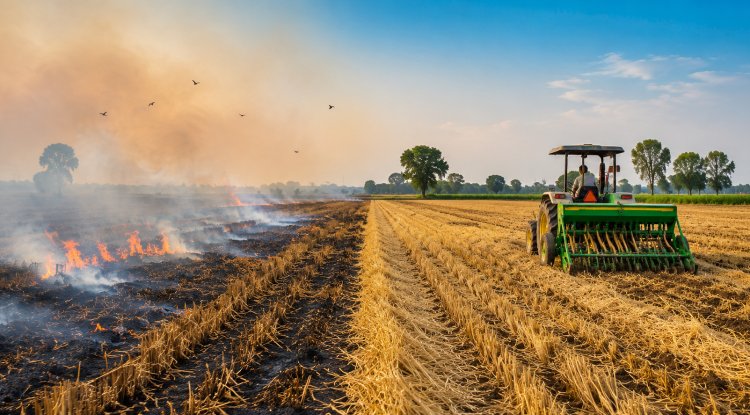
Every year, as autumn approached over the arable lands of Punjab and Haryana, the atmosphere would enter a crisis. The arrival of the autumn season in the fertile plains of Punjab and Haryana had been the time when the atmospheric crisis was at its peak for decades. After paddy harvesting, a countdown began, pushing farmers into a tight schedule to prepare their fields for winter wheat planting. Thousands of farmers had very few options and limited time, leaving them with the only tool they always had: fire. The smoke created during the burning season affected the region and cities, while also removing essential nutrients from the soil. But today, a transformation is taking place beneath our feet. This effort, supported by HDFC Bank Parivartan's corporate social responsibility programme in collaboration with the CII Foundation, is helping local farmers end this cycle and transform crop residues from a source of pollution into soil nutrients.
This change is reflected through the experience of veteran farmer Jora Singh from Majhi village in Sangrur, Punjab. Jora maintained his 20-acre plot through traditional practices for over 40 years, and each October, he burned around 50 tonnes of paddy straw. It was difficult to hire private machinery during the sowing rush due to its high cost and unreliable availability. The turning point came in September 2024, when he attended an awareness camp and learned about the harm caused to soil microbial life and organic carbon due to straw burning. Taking a risk, Jora began managing crop residues across his farm using modern technology and a specially designed Super Seeder available through his village cooperative. The machine mulched the standing straw and sowed wheat in a single operation. His dependence on chemical fertilisers declined, and the return of organic matter to the soil helped reduce his overall dependency on chemical fertilisers. His residue management costs also fell from more than two thousand rupees per acre to nine hundred rupees per acre.
This shift is not limited to middle-aged farmers; it is also being adopted by younger farmers who are looking for alternatives to residue burning. Twenty-nine-year-old Gurveer Singh from Chima village in Ludhiana chose a different approach to agriculture. Having been a farmer since 2015, Gurveer understood the financial pressures that forced fellow farmers to burn crop residue in their fields.
When Happy Seeders and Super Seeders were introduced through the programme's local tool banks, Gurveer moved from trials to adopting the machines on his nine-acre farm. His field preparation costs were reduced by more than 50%, while traditional tillage operations were eliminated in the process. The change has been significant for Gurveer, as the soil he leaves behind for the next generation is expected to be healthier than the one he inherited. The community is following the same trend: by October 2025, nearly 90 per cent of farmers in his village were using alternative methods to manage their crop residue.
The results of this movement reveal an important fact: solving a large ecological crisis does not require smallholder farmers to take on huge capital costs. In Haryana's Fatehabad district, Paramjeet Singh, who manages a small 3.5-acre farm, is aware that there is limited scope for mistakes for any small farmer.
Previously, hiring private equipment was unaffordable for Paramjeet, as he grew a particular variety of paddy that produced an extremely high amount of residue. The cooperative approach adopted by the initiative represents a shift from ownership to accessibility. Paramjeet demonstrated that small-scale farmers can also achieve economic and environmental benefits by hiring Super Seeders and Rotavators locally at subsidised shared rates. Now, his fields have improved water-holding capacity and reduced weed growth. So far, there has been an increase in adoption, even in other villages that were previously identified as environmental red zones.
Thirty-year-old Manjinder Singh, who manages a large 35-acre farm in Sangrur, approached the transition from an entrepreneurial perspective, showing the commercial potential of these practices. In early 2024, Manjinder conducted a controlled pilot project on 10 acres to experience the Super Seeder's performance firsthand. He was satisfied with its effects on soil health and crop production and began using it across his entire farm during the following season. Today, Manjinder uses an integrated system, combining Super Seeders for in-situ soil enrichment and mechanical balers for removing surplus straw for further industrial applications.
In conclusion, the transformation witnessed in Punjab and Haryana highlights efforts towards environmental restoration across the region. It combines corporate investment, community-level institutional support, and agricultural technology to help align farmers' economic interests with environmental objectives. The clearing of autumn skies over villages such as Majhi and Chima each year reflects how farmers are adopting practices that reduce the impact of crop residue burning. They are showing that decades-long pollution from agricultural practices can be addressed through improved tools, awareness, and commitment.
What's Your Reaction?